 EN
EN
 jp
jp  ko
ko  fr
fr  de
de  es
es  it
it  ru
ru  pt
pt  ar
ar  vi
vi  th
th  nl
nl 
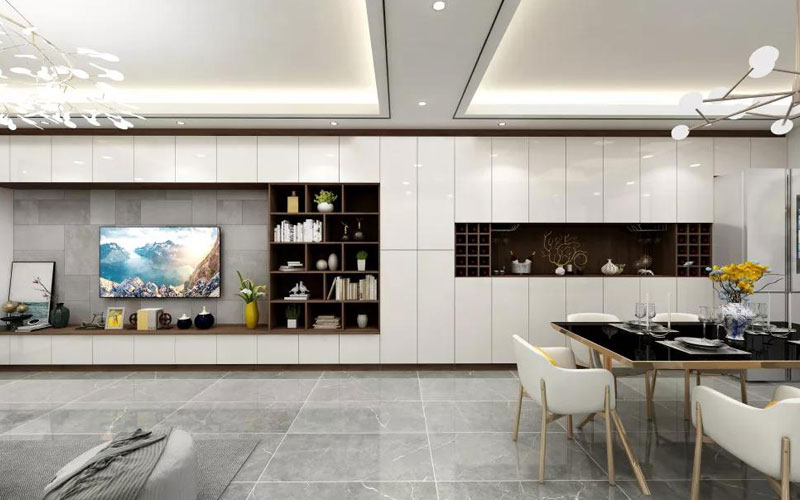
Whole House Design
You can trust .


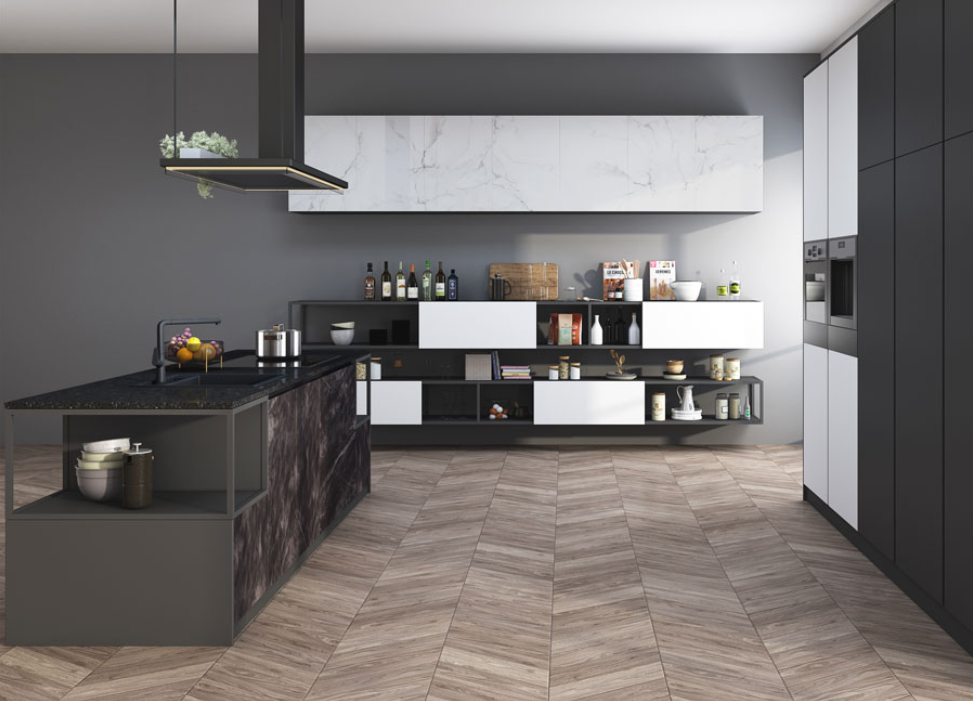
For most hotel, serviced-apartment, and multi-unit residential programs, particle board is often the practical choice because it supports a flat surface, repeatable finishes, stable batch production, and controlled project costs. Plywood is usually more valuable in sink cabinets, bathroom vanities, laundry rooms, and other locations with a higher risk of repeated moisture exposure. The best specification may use both materials in the same project rather than forcing one board into every space.
Particle board is an engineered wood panel made from wood particles bonded together, while plywood is produced by bonding multiple layers of wood veneer. Their different constructions affect how they are specified and used in cabinet manufacturing, so buyers should evaluate the board together with the cabinet design, finish, application, and production requirements.
For B2B buyers, material selection should start with the project specification rather than a general ranking of the two materials.
Factor | Particle Board | Plywood |
Basic structure | Engineered panel made from bonded wood particles | Cross-laminated panel made from multiple wood veneers |
Main project advantage | Flat surface, batch consistency, and cost control | Moisture tolerance, screw holding, and structural robustness |
Moisture strategy | Use a tested moisture-resistant grade and reliable edge sealing in kitchens | Preferred for sink cabinets and other repeatedly wet locations |
Production fit | Efficient for standardized, repeat-unit cabinet programs | Useful where the specification calls for plywood or wet-area performance |
Typical projects | Hotels, serviced apartments, rental housing, and volume residential projects | Sink units, bathroom vanities, laundry rooms, and selected premium projects |
Budget direction | Generally more cost-efficient under comparable specifications | Usually higher material cost; allocate where its performance adds value |
The comparison is most useful when the two materials are evaluated against specific cabinet and project requirements.
Particle board has a uniform engineered structure and a consistently flat surface, helping decorative finishes align cleanly across repeated cabinet doors and panels. For developers and contractors ordering hundreds of units, that repeatability can reduce visible batch differences and make dimensions, colors, and specifications easier to control. It is also generally more budget-friendly than plywood when the complete cabinet specification is comparable.
For example, a developer supplying kitchens across multiple residential units may need the same cabinet dimensions, finishes, and component specifications throughout the project. In such cases, the material should be evaluated as part of the overall production specification rather than as an isolated purchasing decision.
The board is only one part of the finished cabinet. Buyers should also review the cabinet construction, surface treatment, edge finishing, hardware, and overall manufacturing process when defining the product specification.
Particle board is especially relevant to hotel rooms, serviced apartments, rental housing, and other volume projects where a consistent appearance and commercially competitive cabinet package matter. In kitchens or humid climates, buyers can specify a moisture-resistant grade rather than standard board. SNIMAY's P6 moisture-resistant particle board specification combines a moisture-resistant core, waterproof adhesive, a dense surface layer, and PUR edge banding; the referenced technical specification reports 24-hour thickness swelling of no more than 14%. Final orders should confirm the exact board grade and applicable test report.
For buyers, the key question is therefore not simply whether particle board can be used in a kitchen, but which particle-board grade, surface finish, and edge-banding system are specified for that location.
Plywood cabinets use panels made from multiple layers of wood veneer bonded together. The cross-layered structure distinguishes plywood from particle board, which is manufactured from wood particles.
Plywood can be considered when a project specification calls for plywood-based cabinet construction or when the buyer has established plywood requirements for a particular market or product range.
Plywood's cross-laminated veneer structure provides strong screw holding and better tolerance of repeated moisture exposure, making it a practical option for sink cabinets, bathroom vanities, laundry cabinets, and other high-risk wet areas. SNIMAY's referenced plywood configuration uses an 11-layer structure for selected cabinet applications. Buyers should confirm the plywood grade, veneer structure, thickness, adhesive system, and product-specific environmental test report before ordering rather than comparing emission figures obtained under different test methods.
For B2B buyers, it is important to define the plywood specification before placing an order. Thickness, dimensions, surface requirements, cabinet construction, finishing, and intended application should all be confirmed with the supplier.
For customized cabinet programs, buyers should define the required plywood type, thickness, dimensions, surface requirements, and intended application before production. These details help ensure that the material specification is aligned with the final cabinet design.
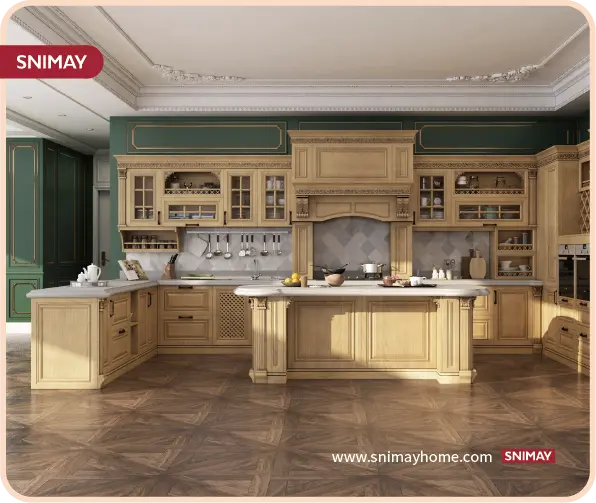
Instead of asking whether particle board or plywood is universally better, B2B buyers should start with the project requirements.
For hotel rooms, serviced apartments, and large residential developments, particle board can provide the flatness, batch consistency, and cost control needed for repeat-unit production. For kitchens and humid coastal markets, a tested moisture-resistant particle board with PUR edge banding can be specified. Plywood is better reserved for sink units, bathroom vanities, laundry rooms, or other areas facing repeated moisture exposure. Premium projects may also specify authorized imported particle-board brands such as EGGER or Kronospan when the tender or owner requires a traceable European board brand.
A mixed-material specification is often the most commercially sensible solution: use each board where its performance creates value, while keeping finishes, hardware, and production standards coordinated through one supplier.
Customized kitchens may require different cabinet sizes, layouts, finishes, and material combinations.
In this situation, material selection should be part of the overall cabinet design process. SNIMAY provides multiple kitchen cabinet material options, including particle board, plywood, MDF, solid wood, Hexiang board, and zero-formaldehyde board across its kitchen cabinet range.
The available material options give project buyers greater flexibility when developing cabinet specifications for different designs, applications, and market requirements.
When ordering cabinets for an established product range, buyers should evaluate whether the supplier can maintain the required specifications, finishes, dimensions, and production standards across different orders.
Both particle board and plywood can be considered, depending on the product positioning and technical requirements.
Material selection is only one part of cabinet procurement. Before production begins, B2B buyers should confirm the material specification, cabinet construction, finishing requirements, hardware, and delivery conditions.
Do not specify a cabinet simply as "particle board" or "plywood." Confirm the required board type, thickness, dimensions, and relevant material specifications.
The finished cabinet includes more than its core board. Buyers should review the cabinet structure, door construction, hardware, assembly method, and other components that form part of the final specification.
The surface finish should match the design requirements, while edge treatment should be clearly defined for the production order.
Hinges, drawer systems, connectors, and other hardware are important components of a kitchen cabinet. SNIMAY states that it works with international hardware brands including Hettich, Blum, and DTC.
For overseas projects, buyers should discuss drawings, specifications, packaging, delivery format, logistics, and installation requirements with the supplier before production begins.
SNIMAY describes a project process covering quotation or drawing initiation, drawing analysis, design and approval, contract signing, logistics, and installation. Its website also states that cabinets can be supplied in assembled or KD form according to customer requirements.
For B2B projects, supplier capability often matters more than the board name alone. Procurement teams need evidence that the factory can control incoming materials, panel dimensions, surface quality, moisture-related performance, edge banding, hardware installation, and batch consistency before shipment. SNIMAY's quality process includes incoming-board inspection and sampled acceptance checks; material claims should be matched to the relevant CMA/CNAS-qualified test report and the specification written into the order.
SNIMAY supports this process with three manufacturing bases in Guangzhou, Jingmen, and Guiyang, German HOMAG panel-processing lines, and an integrated design-to-order-to-production workflow. Depending on the selected product, SNIMAY can provide ENF-grade and antibacterial board options, authorized EGGER and Kronospan materials, and supporting ISO management-system and environmental certifications. These capabilities are valuable to developers, contractors, distributors, and overseas furniture brands that need traceable specifications and consistent delivery across volume orders.
For overseas buyers, this integrated approach can simplify communication by allowing material, cabinet design, and project requirements to be discussed with one supplier.
SNIMAY offers multiple material options across its kitchen cabinet range. Depending on the cabinet product and design, these include:
Particle board
Plywood
MDF
Solid wood
Hexiang board
Zero-formaldehyde board
This range gives B2B buyers flexibility when different projects require different cabinet specifications, product positioning, or design approaches.
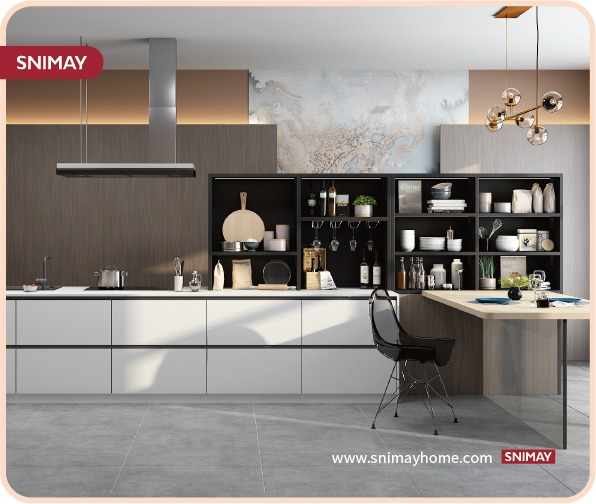
Neither material is universally better. The choice should be based on the project's cabinet specifications, intended application, production requirements, and budget. SNIMAY offers both particle board and plywood as kitchen cabinet material options.
Yes. Particle board is one of the material options available for SNIMAY customized kitchen cabinets. The appropriate board specification should be determined according to the cabinet design, application, and project requirements.
Yes. Plywood is one of the kitchen cabinet base material options listed by SNIMAY. Buyers can discuss the required plywood specification with the manufacturer according to the cabinet design and project requirements.
B2B buyers should confirm the board grade and thickness, intended cabinet location, moisture exposure, finish and edge-banding system, screw-holding requirements, hardware, order volume, inspection criteria, replacement policy, packaging, and delivery format. Any stated performance value should be tied to the exact ordered specification and its applicable test report.
SNIMAY offers multiple kitchen cabinet material options, including particle board, plywood, MDF, solid wood, Hexiang board, and zero-formaldehyde board, depending on the product.
Use the exposure level to decide. A tested moisture-resistant particle board with sealed surfaces and PUR edge banding can suit normal kitchen humidity and humid climates, while plywood is the safer direction for sink cabinets and other locations exposed to repeated water. Confirm the final board and edge specification with the supplier.
Particle board is often the more practical option for hotel rooms, serviced apartments, and multi-unit housing because its flatness and manufactured consistency support repeatable finishes and controlled costs. Plywood can still be allocated to wet-area cabinets within the same project.
The choice between particle board and plywood cabinets should be based on the requirements of the project rather than a general ranking of the two materials. Particle board cabinets can be considered for projects that prioritize standardized specifications and repeatable production, while plywood cabinets may be specified when plywood construction is part of the project's requirements.
For B2B buyers, material selection should be evaluated together with cabinet construction, finish, hardware, production requirements, and supplier capabilities. Defining these requirements before production can help ensure that the final cabinet solution matches the project specification.
SNIMAY provides customized kitchen cabinet solutions with multiple material options, including particle board and plywood, giving project buyers flexibility when developing cabinet specifications for different applications and markets.
 Call us on:
  Email Us:
  Snimay Headquarters, Building 6, Panyu E Valley, Panyu District, Guangzhou City, Guangdong Province, China