 EN
EN
 jp
jp  ko
ko  fr
fr  de
de  es
es  it
it  ru
ru  pt
pt  ar
ar  vi
vi  th
th  nl
nl 
Whole House Design
You can trust .


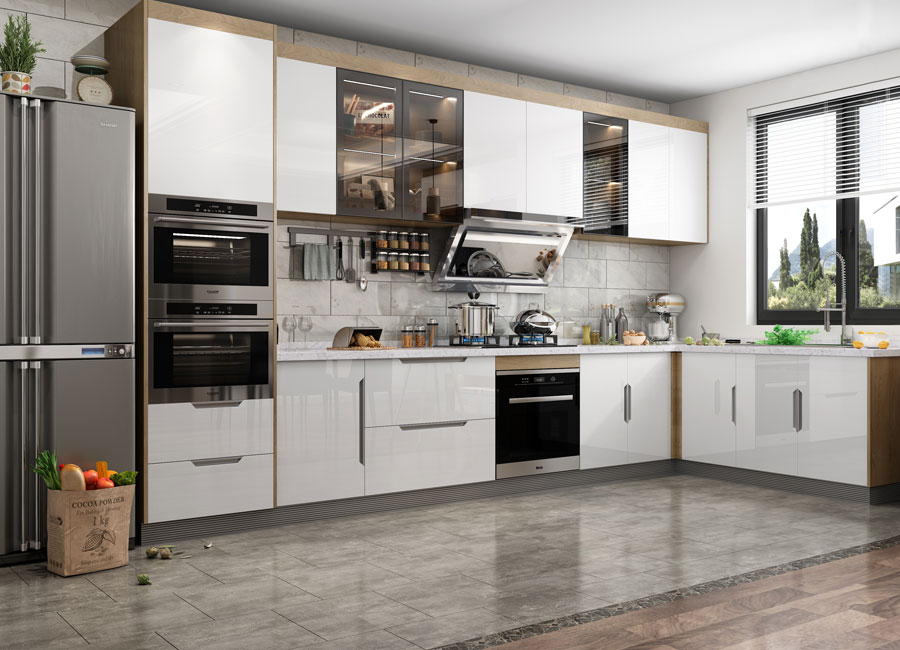
PVC and lacquer kitchen cabinets can both work well in residential and commercial projects, but they suit different purchasing priorities. PVC kitchen cabinets are often practical for repeatable, cost-conscious projects, while lacquer cabinets are more suitable when color flexibility and a painted finish are central to the design.
For contractors, cabinet dealers, wholesalers, and property developers, the right choice is not simply about which finish looks more attractive. Production consistency, maintenance, heat exposure, design requirements, and project positioning all affect the decision.
At the product level, PVC and lacquer are essentially different decorative surface solutions for cabinet panels. The finish affects not only the appearance and touch of the cabinet, but also the production process, customization options, performance characteristics, and final project cost. This is why a practical PVC finish can be a better fit for a large apartment program, while lacquer can be worth the additional investment in a premium, design-led residence.
The main difference is the cabinet-door process: PVC uses a thermoformed film bonded to a panel, while lacquer creates a painted coating on the cabinet surface.
Understanding this construction difference helps buyers evaluate how each option may perform during production, installation, and everyday use.
PVC kitchen cabinet doors typically use a polyvinyl chloride (PVC) film vacuum-formed over an engineered-wood substrate, commonly medium-density fiberboard (MDF). The film can wrap across the face and shaped edges of a cabinet door, creating a continuous surface.
This manufacturing method allows PVC doors to be produced in different colors, textures, and profiles. SNIMAY, for example, describes its PVC cabinet construction as engineered wood panels such as MDF or particleboard covered by PVC through vacuum heat bonding.
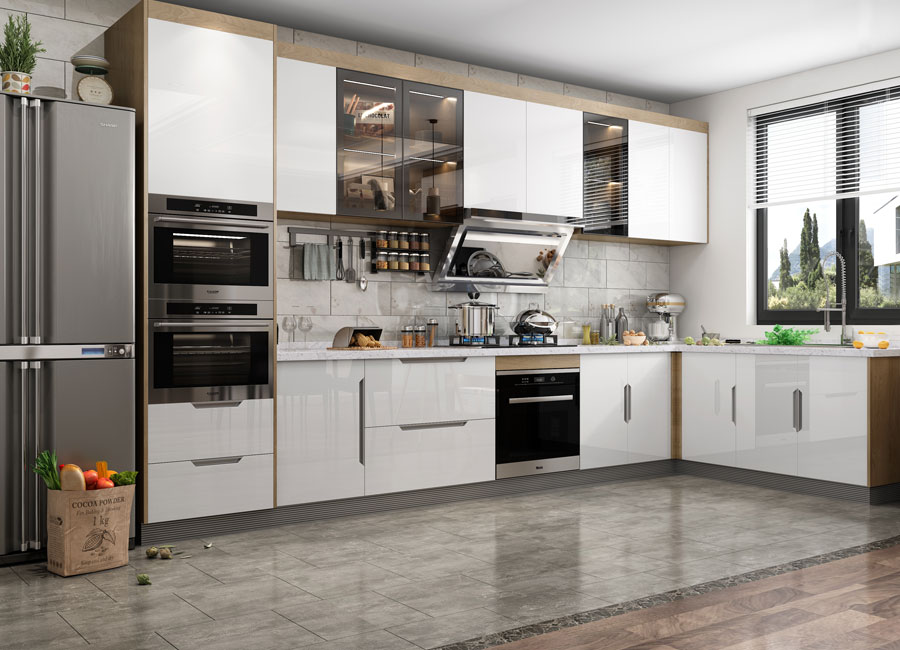
Lacquer kitchen cabinets use a coating system applied directly to the cabinet surface rather than a separate PVC film. Depending on the manufacturer and coating system, several preparation and coating stages may be required to achieve the intended color and surface quality.
Lacquer is commonly associated with smooth painted surfaces and a broad choice of colors. However, performance depends on the actual coating formulation and application process. Industrial lacquer systems can, for example, be formulated specifically for moisture and household-chemical resistance.
SNIMAY lacquer cabinets use a three-layer lacquer system. Each layer is applied in a dust-controlled workshop and cured at high temperature before the next coating stage begins. This disciplined, multi-stage process helps produce a smoother, more consistent painted surface with better color uniformity and visual depth—an immediate advantage in premium kitchens where cabinet doors are a major part of the interior design.
Another advantage of lacquer is its flexibility in color customization. Using professional color references such as RAL and Pantone, SNIMAY can support 1:1 color matching to a specified project color or approved sample. This gives designers greater freedom to coordinate cabinet colors with walls, stone, flooring, wood finishes, and other interior elements, while helping procurement teams maintain a consistent color standard across the project.
For premium residences, this level of customization can make the higher cost of lacquer easier to justify because the finish can contribute directly to the overall interior design rather than simply adding to the cabinet price.
Factor | PVC Cabinets | Lacquer Cabinets |
Surface | PVC/thermofoil film | Applied coating |
Typical substrate | Often MDF or engineered wood | Depends on cabinet system |
Appearance | Matte, gloss, solid colors, wood-look finishes | Smooth painted appearance |
Color options | Determined largely by available films | Broad painted-color flexibility |
Maintenance | Smooth surface is generally easy to wipe | Requires careful surface cleaning |
Heat consideration | Film-to-core bond needs protection from excessive heat | Performance depends on coating system |
Typical project fit | Repeatable, value-focused projects | Design-led and customized projects |
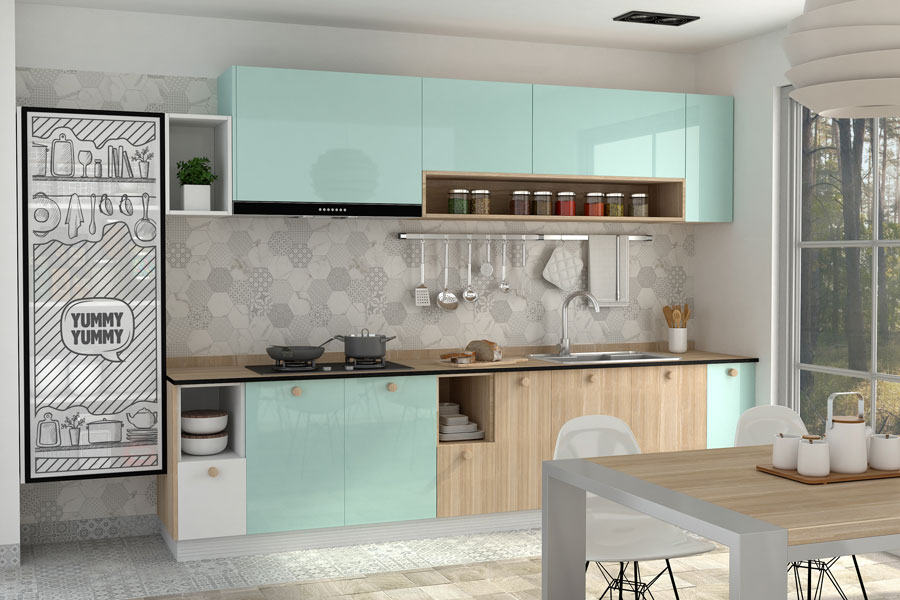
Yes, PVC kitchen cabinets can be a practical choice for B2B projects when buyers prioritize repeatable finishes, straightforward maintenance, and scalable cabinet production.
The important question is not simply “are PVC kitchen cabinets good?” but whether the material fits the project's environment, price positioning, installation conditions, and expected service level.
For renovation contractors and cabinet distributors, one advantage is finish consistency across repeated cabinet doors. A specified PVC film can help maintain a coordinated appearance across multiple units when production controls are consistent.
SNIMAY combines PVC cabinet production with precision panel processing on German HOMAG cutting and edge-banding lines, together with PUR edge-banding technology. PUR polyurethane hot-melt adhesive creates a tighter, more moisture- and heat-resistant edge seal than conventional edge-banding solutions. For customers, this means stronger protection at vulnerable panel edges and more consistent processing across repeated cabinet components—particularly valuable for kitchens and multi-unit projects.
PVC also accommodates routed profiles, curved details, and rounded door shapes because the heated film can conform to the shaped MDF substrate. This allows project buyers to create more dimensional cabinet designs without being limited to completely flat doors, while retaining a repeatable finish suitable for volume production.
For buyers sourcing PVC cabinets for kitchen projects, practical advantages may include:
Multiple matte, gloss, solid-color, or wood-look options
Smooth surfaces that are straightforward to clean
Compatibility with repeatable cabinet configurations
Ability to cover shaped MDF door profiles
Suitability for apartment, renovation, dealer, and project orders
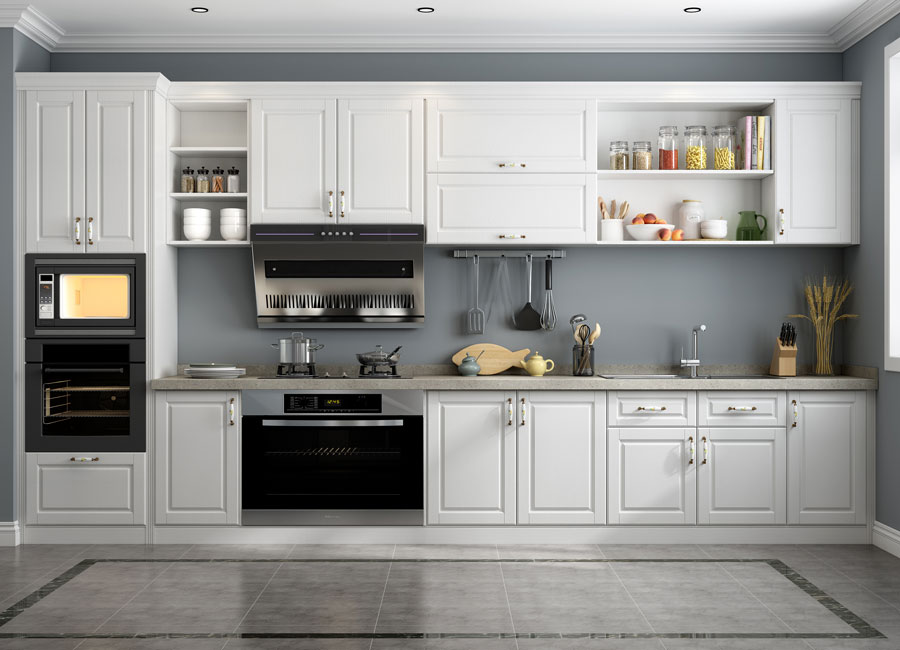
Heat exposure is one of the most important factors to assess with thermofoil cabinet doors. Prolonged or concentrated heat can affect the bond between PVC film and the underlying panel, which may lead to lifting or delamination if the product, appliance layout, or installation is unsuitable.
Buyers should therefore review cabinet positions around ovens, cooktops, dishwashers, and other heat or steam sources. Manufacturer instructions regarding appliance clearance, heat shielding, installation, and maintenance should form part of project approval.
Physical damage also needs consideration. If PVC film is deeply cut or begins separating from the substrate, local cosmetic repair can be difficult, while lacquer repair requirements depend on the coating system, color, gloss level, and extent of the damage.
B2B buyers should check these points before ordering:
PVC film specification and finish sample
Core material and panel construction
Edge and vacuum-forming quality
Heat-source layout
Door dimensions and profiles
Replacement-door availability
Packaging and installation requirements
In practical terms, this often makes PVC the more sensible choice for apartment developments and other large-volume residential programs. Even a high-end apartment project may not need lacquer for every unit if the additional cost does not deliver enough value to the target buyer. PVC can provide a polished, contemporary appearance while keeping the cabinet package more commercially competitive.
Lacquer becomes more compelling when the cabinet itself is part of the design statement. In luxury residences or highly customized interiors, the smoother painted appearance and greater freedom in color matching can provide a level of visual customization that is harder to achieve with a fixed PVC film selection.
Neither option is automatically appropriate for every kitchen. Procurement teams should connect the finish to the project's commercial model.
Project Scenario | Option to Consider | Main Reason |
Rental renovation | PVC | Repeatable finish and practical maintenance |
Multi-unit apartment project | PVC | Suitable for standardized cabinet programs |
Local dealer program | PVC or lacquer | Depends on target customer and price segment |
Color-specific interior project | Lacquer | Greater painted-color flexibility |
Design-led residential project | Lacquer | Smooth painted appearance |
Mixed development portfolio | Both | Different finishes can serve different project tiers |
Cost should also be evaluated at the complete cabinet-program level, not just by door finish. Door style, core board, hardware, cabinet dimensions, internal accessories, packaging, shipping, and order volume can all change the final quotation.
For project buyers, choosing the finish is only the first step; the bigger decision is whether the supplier can support material selection, production consistency, quality control, and batch delivery as one coordinated system.
SNIMAY offers a broad, all-price finish portfolio with 17 major surface technologies and more than 150 available colors and patterns—from melamine and PVC to PET, EB electron-beam-cured finishes, natural veneer, sintered stone, and leather. This allows public areas, guest rooms, kitchens, and wardrobes within one project to be coordinated through a single supplier, reducing multi-vendor sourcing and communication costs.
Its manufacturing base is built for project delivery. SNIMAY operates three intelligent production bases in Guangzhou, Jingmen, and Guiyang, supported by German HOMAG automated cutting and edge-banding lines and an integrated design-to-order-to-production workflow. For developers and contractors, this helps reduce batch variation and capacity risk on repeat-unit orders.
Material and quality controls are designed around project acceptance requirements. Main substrate options reach China's ENF formaldehyde-emission grade, while authorized EGGER and Kronospan decorative panels provide traceable European-brand sourcing. Incoming-board inspection, finished-door checks, and third-party physical and chemical testing help control issues such as delamination, blistering, and visible scratches before delivery.
SNIMAY also holds ISO 9001, ISO 14001, and ISO 45001 management-system certifications, together with China Environmental Labeling and Green Product certification. These credentials, combined with its finish range and manufacturing capacity, give project buyers a clearer path from design approval to compliant, scalable delivery.
SNIMAY supplies both PVC and lacquer kitchen cabinet options and supports customized project procurement, giving B2B buyers access to both finish routes from one manufacturer.
Founded in 2003, SNIMAY operates across kitchen cabinets, wardrobes, whole-house customization, doors, and other furniture categories. Its positioning is relevant to developers, contractors, dealers, and other buyers sourcing coordinated cabinet programs.
For buyers evaluating SNIMAY PVC kitchen cabinets, the company states that PVC finishes are vacuum heat-bonded over engineered wood panels such as MDF or particleboard. It also provides OEM/ODM manufacturing and can customize cabinet dimensions and structural layouts according to project drawings.
SNIMAY also manufactures lacquer kitchen cabinets and states that its lacquer production and cabinet finishing are handled in-house. Its lacquer offering includes multiple finish options, while its cleaning guidance recommends a soft damp cloth and mild detergent where necessary.
For project buyers, SNIMAY outlines a process covering quotation or drawing submission, drawing analysis, design approval, contracting, logistics, and installation support. Cabinets can also be packed assembled or knock-down depending on project requirements.
Before requesting a quotation, buyers can prepare:
Project drawings and cabinet dimensions
Required PVC or lacquer finish
Color and surface samples
Door and cabinet construction requirements
Hardware specifications
Order quantity
Packaging requirements
Installation method
Destination market requirements
Providing these details upfront can help SNIMAY confirm material options, cabinet construction, hardware, packaging, and installation requirements before production. For project orders, buyers can also submit drawings or specifications for review during the quotation stage.
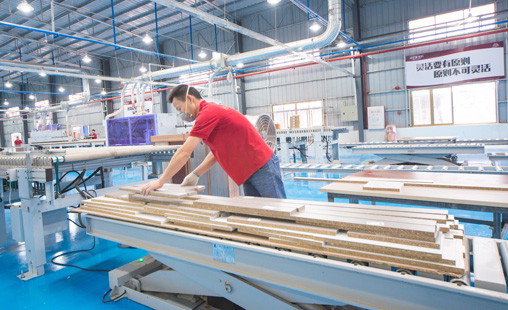
Choose PVC kitchen cabinets when a project prioritizes repeatability, practical maintenance, and standardized production; consider lacquer when custom color and a painted surface are more important to the design brief.
For B2B buyers, the final decision should also account for cabinet construction, heat exposure, project scale, hardware, replacement requirements, installation, and target-market positioning.
Rather than asking whether PVC or lacquer is universally superior, contractors, dealers, and developers can compare both finishes against the actual operating and commercial requirements of each project. SNIMAY's PVC and lacquer cabinet ranges give project buyers the option to specify either approach within a customized cabinet procurement program.
 Call us on:
  Email Us:
  Snimay Headquarters, Building 6, Panyu E Valley, Panyu District, Guangzhou City, Guangdong Province, China