 EN
EN
 jp
jp  ko
ko  fr
fr  de
de  es
es  it
it  ru
ru  pt
pt  ar
ar  vi
vi  th
th  nl
nl 
Whole House Design
You can trust .


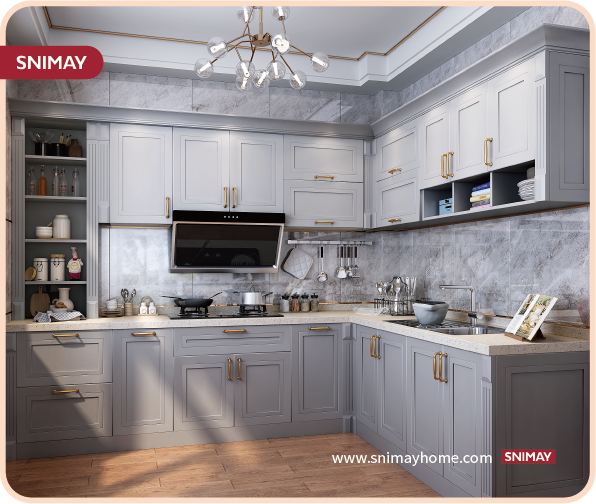
Selecting kitchen cabinetry for multi-family developments or residential builds is a crucial decision for property developers, architects, and procurement managers. Kitchens serve as functional hubs in modern homes, making cabinetry a visible architectural feature.
Evaluating authentic timber cabinetry requires balancing aesthetic warmth, structural performance, and long-term investment value. Understanding the performance profile of natural wood helps buyers make informed sourcing decisions aligning with project budgets and quality expectations.
.png "图片1(3).png")
Primary Advantages of Solid Wood Cabinetry
Incorporating authentic wood into kitchen environments offers distinct aesthetic and physical benefits that significantly enhance property appeal and overall marketability.
1.Exceptional Aesthetic Appeal and Timeless Character
Natural timber brings organic warmth, visual depth, and unique character to kitchen spaces. Because grain patterns vary naturally across every tree, no two cabinet doors are identical. Applying protective stains or clear finishes highlights these natural variations across diverse design styles.
2.Superior Load-Bearing Strength and Durability
Dense timber species offer high tensile strength and structural rigidity compared to lightweight fiberboard alternatives. Solid wood face frames, door stiles, and drawer fronts hold heavy mounting hardware securely, maintaining proper door alignment over years of constant daily use.
3.Refinishing and Long-Term Repairability
One of the most significant operational benefits of natural wood is its repairability. While laminated panels often require total replacement when deeply gouged or chipped, authentic wood can be sanded, filled, touched up, or completely refinished on-site over time.
Key Challenges and Environmental Considerations
Despite its durability and premium appeal, natural timber exhibits physical characteristics that commercial procurement teams must manage carefully during planning and installation.
1.Environmental Sensitivity and Expansion
Wood is an organic material that naturally absorbs and releases moisture in response to ambient humidity shifts. In regions with fluctuating climate conditions, unsealed or improperly conditioned wood can expand, contract, or warp, putting stress on door joints.
2.Higher Initial Investment
Sourcing high-grade timber, kiln-drying it to stable moisture levels, and crafting precise joinery involves higher raw material and labor costs compared to standard composite boards. Procurement teams must weigh this higher outlay against long-term asset value.
3.Weight and Substructure Requirements
Dense timber assemblies are significantly heavier than synthetic flat-pack cabinetry. Consequently, installation crews must use heavy-duty fasteners and verify that wall framing provides adequate structural support to anchor upper cabinet runs safely.
Essential Technical Standards for Commercial Buyers
To ensure natural timber cabinetry performs reliably in commercial applications, buyers should audit manufacturing processes against key technical benchmarks:
Controlled Kiln-Drying: Timber is kiln-dried in monitored facilities to optimal moisture levels (6% to 8%) before milling, stabilizing fibers and preventing post-installation warping.
Multi-Layer Protective Sealants: Commercial installations require non-porous topcoats like UV-cured polyurethanes. These sealers protect the wood grain against liquid spills, steam, chemicals, and everyday wear.
Precision Joinery Standards: Structural joints, including dovetail drawer boxes and mortise-and-tenon door frames, distribute mechanical stresses evenly to prevent joint failure under heavy operational loads.
Manufacturing Quality and Global Supply Chain Integration
Achieving a balance between traditional wood craftsmanship and strict commercial construction timelines requires advanced production capabilities and reliable supply chain execution.
At SNIMAY, we combine automated manufacturing precision with rigorous quality controls to produce high-grade solid wood kitchen cabinets. SNIMAY combines automated manufacturing capabilities with quality control processes to support consistent production of solid wood kitchen cabinets for commercial orders.
Our engineering team ensures every kitchen cabinet solid wood unit undergoes systematic moisture testing, automated sanding, and precision multi-coat finishing. This industrial precision guarantees that every panel meets strict international quality benchmarks while offering high dimensional stability.
We also focus on delivering engineered solid wood kitchen cabinets designed specifically to withstand demanding commercial use. Our automated panel processing maintains tight joinery tolerances and uniform surface protection across every bulk shipment.
When managing kitchen cabinet solid wood orders, our logistics team ensures every carton is optimized for safe container stacking density. This packaging optimization significantly reduces transit damage risks for commercial procurement buyers worldwide.
Through our dedicated kitchen cabinet solid wood distribution channels, we provide developers with dependable lead times and transparent fulfillment tracking. Our scalable operations minimize procurement risks across complex multi-phase construction schedules.
By partnering with SNIMAY, commercial procurement managers gain access to scalable production capacity, predictable lead times, and transit-ready protective packaging designed to safeguard finished wood surfaces during ocean shipping and final site delivery.
Environmental Compliance and Quality Certifications
Modern building projects increasingly require materials that comply with global green building standards and indoor environmental health codes. Responsible timber sourcing and non-toxic finish treatments are essential criteria for contemporary real estate developments.
SNIMAY lists ISO9001 Standard and EPA NAF Certification among its quality and environmental credentials. SNIMAY highlights environmental considerations in its manufacturing approach, including EPA NAF certification, supporting developers in obtaining recognized sustainability certifications effortlessly.
Furthermore, as an established global manufacturer, SNIMAY conducts rigorous internal quality audits on raw timber batches, adhesive bonds, and joinery strength. This commitment ensures that every solid wood kitchen cabinets order delivered meets international commercial durability standards.
A High-Value Solution for Commercial Projects
When evaluating structural longevity, aesthetic prestige, and long-term asset value, authentic timber remains an outstanding choice for premium residential construction. It delivers high tenant appeal while maintaining structural reliability across property lifecycles.
Selecting authentic timber cabinetry provides multi-family building projects with high market appeal and lasting operational performance. Factoring in factory-controlled moisture treatments, multi-layer topcoats, and bulk supply capabilities helps procurement teams streamline sourcing while securing high-performance solid wood kitchen cabinets built to withstand the demands of modern residential living.
 Call us on:
  Email Us:
  Snimay Headquarters, Building 6, Panyu E Valley, Panyu District, Guangzhou City, Guangdong Province, China